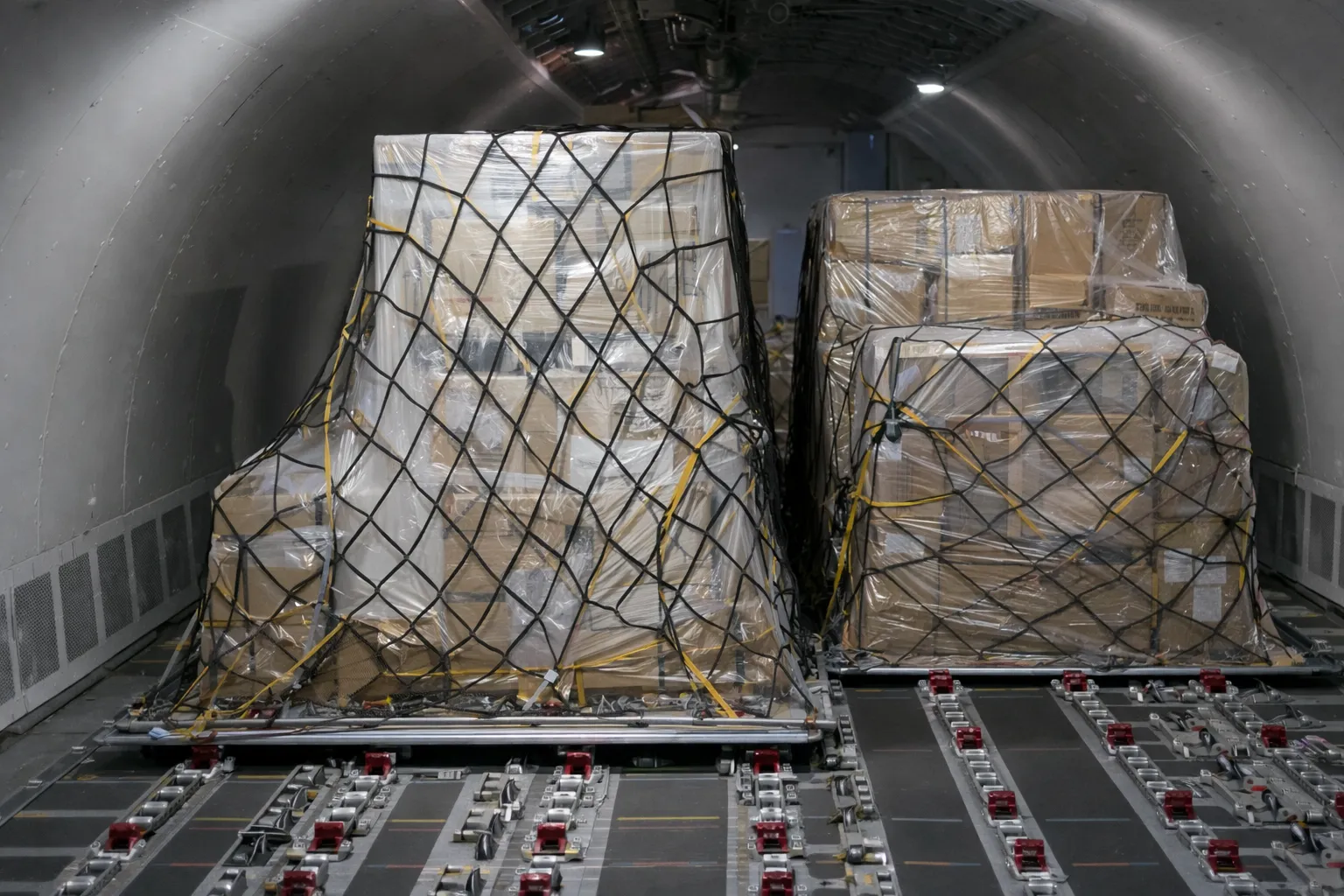
Aircraft pallets being loaded into a cargo aircraft
Solutions Industries ULD optimization
Packing, Loading & Stowage

ULD optimization for air cargo

Safe, compliant, and operationally feasible ULD build-up plans for aircraft containers and aircraft pallets with nets.

In air cargo, it is not enough to pack shipments as tightly as possible. What matters is a safe, compliant, and operationally feasible build-up of unit load devices. That is exactly where our ULD optimization comes in.

ULDs and their build-up follow specific rules for specification, handling, build-up, restraint, and serviceability. Downstream, aircraft loading is tightly linked to load planning and weight and balance. Our software models those relationships in one continuous optimization logic.

Why ULD planning is especially demanding

Contour, weight, and secure restraint must all be satisfied at the same time

Warehouse feasibility matters just as much as packing density

Load planning and weight and balance start with good ULD build-up

What ULD optimization means

Air-cargo-specific packing and loading optimization instead of pure density

ULD optimization is the air-cargo-specific form of packing and loading optimization. The goal is to assign shipments to ULDs and arrange them inside each ULD so weight and volume are used economically without violating operational or regulatory restrictions.

As soon as finished ULDs also need to be placed onto aircraft positions, downstream aircraft load planning and weight-and-balance processes begin. That is why ULD build-up is a safety-critical and operationally sensitive process far beyond simple packing.

ULD planning is far more restrictive than pure packing-density optimization

Contour, weight, load distribution, stability, and secure restraint all need to fit together

Airline, handling, and product specifics directly affect real build-up quality

A dense build-up is useless if it cannot be built cleanly in the warehouse

Cut-off times, changing shipment structures, and expensive capacity create constant pressure

ULD optimization is therefore a utilization, safety, and process-quality problem at the same time

Secured aircraft pallets inside an aircraft cargo hold
Typical ULD build-up challenges

Where air-cargo planning quickly hits limits without structure

Many air-cargo shipments are heterogeneous, time-critical, and shaped by additional product and handling rules. In exactly this environment, it becomes clear whether build-up decisions are robustly prepared or drift into improvisation and rework.

Combine heterogeneous shipments reliably

Different dimensions, weights, packaging types, and center-of-gravity characteristics meet directly inside ULD build-up. Bulky, irregular, pressure-sensitive, or non-stackable cargo makes manual planning error-prone very quickly.

Enforce air-cargo restrictions consistently

Not every shipment can be combined with every other, not every orientation is allowed, and not every ULD is suitable for every downstream process. Dangerous goods, temperature-controlled freight, live animals, or other special cargo add further compatibility and handling rules.

Optimize weight and contour together

In air cargo, it is not enough to fill a ULD as much as possible. Contour, allowable outer dimensions, weight limits, and center of gravity must work together so the ULD remains safe, compliant, and usable in downstream aircraft processes.

Protect practical feasibility in the warehouse

Even mathematically strong build-up plans lose value if they are impractical on the floor. Clear build sequence, robust decisions under time pressure, and a structure that supports restraint and serviceability matter just as much as density.

Plan reproducibly under time pressure

Short cut-off times and heavily changing shipment patterns leave little room for manual iteration. Good ULD optimization delivers traceable, standardized, and quickly usable planning suggestions under those conditions.

Prepare load planning and weight-and-balance follow-up

ULD build-up does not stop at packing. Cleanly planned ULDs create the foundation for downstream aircraft load planning and weight-and-balance processes to continue from stable input data.

Built aircraft pallet with stacked cartons in a warehouse
What our software delivers

Robust ULD build-up plans

Our software supports ULD build-up planning with mathematical optimization and practical restriction logic. It decides not only which shipment belongs on which ULD, but also how packages should be arranged inside each ULD.

The result is a planning recommendation that does not just look good theoretically, but can actually be executed in warehouse operations and prepares downstream air-cargo processes cleanly.

Fit shipments to the right ULD type

Optimization decides not only how packages are arranged inside a ULD, but also which shipments should be assigned to which ULD type in the first place.

3D arrangement inside the ULD

Our software computes robust 3D build-up plans for aircraft containers and aircraft pallets so the results remain compact, operationally understandable, and easy to visualize.

Contour and allowable outer dimensions

ULD contours, outer dimensions, and operational usage limits are modeled directly so optimization does not generate theoretical yet invalid build-up plans.

Weight limits and load distribution

Gross weights, load distribution, and centers of gravity flow directly into planning. That creates build-up structures that are not only dense, but also stable and reusable downstream.

Stability and secure execution

Optimization supports stable support areas, sensible stacking sequences, and structures that can be restrained reliably with nets or other securing devices.

Reduce empty space and unnecessary ULDs

Free volume is used better, extra ULDs are reduced, and scarce capacity is deployed more economically without sacrificing compliance.

Prepare downstream processes

The generated suggestions create cleaner starting structures for downstream processes such as load planning, weight and balance, and operational build-up execution.

Relevant planning requirements

Which restrictions really decide ULD build-up quality

In air cargo, contour, weight, stability, secure restraint, and product logic all need to fit together. Good ULD optimization therefore looks beyond packability and models the full operational and regulatory reality of build-up execution.

ULD types, contours, and operational limits

Different ULD types come with different contours, dimensions, and operational characteristics. Those limits must already be modeled correctly in optimization so later handling and aircraft use remain possible.

Weight, load distribution, and center of gravity

Not only gross weight matters, but especially how weight is distributed inside the ULD. Good planning avoids critical centers of gravity and builds stable prerequisites for downstream weight-and-balance work.

Stability and secure restraint

A ULD must not only be filled, but also built and restrained safely. Stable support areas, sensible stacking sequences, reduced cavities, and a clean restraint logic are essential.

Shipment attributes and special restrictions

Orientation rules, pressure sensitivity, no-stack restrictions, overhangs, irregular geometries, or special cargo such as dangerous goods and temperature-controlled freight all influence ULD build-up directly and need to be modeled consistently.

Operational feasibility in the warehouse

Beyond packing density, the result must be practical on the floor. Traceable build sequences, clear visualization, and robust suggestions under heterogeneous inputs are crucial in daily build-up operations.

Typical requirements for robust ULD planning

Correct selection and assignment of ULD types and contours
Allowable outer dimensions, contour rules, and operational limits
Weight limits, load distribution, and center-of-gravity constraints
Stable support areas, stacking logic, and secure restraint structures
No-stack, pressure-sensitive, and orientation-dependent goods
Compatibility rules and mixing bans between cargo groups
Special rules for dangerous goods, temperature-controlled freight, or live animals
Reduction of empty space and unnecessary extra ULDs
Preparation for build-up execution, handling, and weight-and-balance processes
Clear visualization and traceable build sequence for warehouse teams

Your benefits

More utilization, more process reliability, and more transparency

ULD optimization is not only about utilization, but also about process reliability, planning quality, and operational repeatability. Strong build-up plans reduce errors, speed up decisions, and improve the usability of scarce air-cargo capacity.

At the same time, downstream fit improves because warehouse, handling, and later aircraft-planning processes can work with cleaner and better prepared ULD structures.

Higher weight and volume utilization

Free volume is used better, empty space is reduced, and unnecessary extra ULDs are avoided. That improves capacity utilization and supports more economical air-cargo operations.

More process reliability

Compliant and stable ULD structures reduce improvised decisions in daily operations. Planning becomes more reproducible, more transparent, and less dependent on individual expert knowledge.

Faster and standardized planning

Complex shipment structures can be evaluated much faster than in manual planning processes. Teams receive structured and consistent suggestions for daily execution.

Better transparency

Visualized ULD build-up plans create clarity between planning and operations. Restrictions, decisions, and alternatives are easier to understand and compare.

Stronger downstream fit

ULD optimization does not end at packing. It creates clean starting structures for build-up execution, handling, and downstream aircraft loading processes.

Who the solution is for

Relevant for anyone who wants air cargo to become more planable and more economical

Airlines

For carriers that want to plan ULD build-up, capacity usage, and operational quality in air cargo more systematically and economically.

Ground handling companies

For operators that need to execute compliant build-up processes reproducibly under heavy time pressure and require visually understandable build-up plans.

Cargo handling agents and air-cargo terminals

For operational environments with heterogeneous shipments, multiple kinds of special freight, and demanding handling restrictions.

Freight forwarders with air-cargo activities

For companies that do not just accompany ULDs administratively, but actively want to optimize build-up and capacity decisions.

Logistics providers with in-house ULD build-up

For providers running build-up operations under their own responsibility and needing algorithmic support for operational constraints.

Shippers with regular air-cargo volumes

Especially valuable for companies with demanding special-cargo structures, high capacity pressure, or shipper-built ULD scenarios.

Two workers securing freight on an aircraft pallet with netting
Continuous planning chain

ULD optimization as part of a larger air-cargo planning logic

ULD optimization rarely stands alone. In many processes, it is part of a larger planning chain: from shipment consolidation to packing and assignment logic, build-up execution, and later aircraft loading. That is where the leverage of continuous optimization becomes visible.

Shipment consolidation and assignment logic

Planning does not start inside the individual ULD. Which shipments are combined and which ULD type is suitable already determines later build-up quality.

ULD build-up and operational execution

From there, concrete build-up plans are created that respect warehouse, handling, and restraint requirements together and stay executable in practice.

Aircraft load planning and weight and balance

Cleanly built ULDs create stable starting points for later aircraft planning. That interface is exactly where the benefit of one continuous planning chain becomes visible.

Open cargo aircraft loaded with secured freight pallets at dusk

ULD optimization with robust algorithmic logic

Anyone who wants to plan ULDs efficiently needs more than pure geometry. The real requirement is optimization that models contour, weight, load distribution, stability, compatibility, and operational execution together.

Build ULD processes on a reliable foundation

Talk to us if you want to put air-cargo packing optimization and ULD build-up on a sound algorithmic basis

Our software connects compliant packing logic, stable ULD structures, and practical feasibility in the warehouse. That creates build-up plans that integrate cleanly into existing air-cargo processes and hold up under daily pressure.

Request a demo

If you want to make ULD build-up, air-cargo packing, and related planning processes more systematic, safer, and more economical, we can show how to build the right optimization logic for that operating reality.